RFF#71 – 100% of industry sponsored nutrition intervention research results favour the financial interests of the sponsors

“Most days of the year are unremarkable. They begin, and they end, with no lasting memories made in-between. Most days have no impact on the course of a life…”             (quote from “500 Days of Summer”)

Today was not one of those days.Today, I made a realization that I will never forget (and no, I’m not talking about Rob Ford’s shenanigans).

Here’s what I realized…

I was taught in my undergrad that the purpose of research is to produce knowledge. And in grad school I’ve learned that funding is what produces research. Today I made the connection that…if industry produces funding…and funding produces research…and research produces knowledge…then ultimately…INDUSTRY produces KNOWELDGE…this is a problem. 

Here’s how I realized it…

The day started as most “at-home” work days do. I turned on my computer and started  working…keep reading, it’s going to get more interesting…Because I’m presently preparing for my comprehensive exam (a two hour oral beast-of-an-exam that all doctoral students face)  I have a huge stack of research papers to read through. While reading my first paper of the morning, I got distracted by a typo in the acknowledgements section of the paper. Upon seeing the typo, my eyes were drawn to the “Conflicts of Interest” (COI) section of the article (that’s there authors declare that they haven’t received any money from the food industry or anyone else who could have financial interests in the research results). Normally, the COI section is quite short…normally, I pay no attention to it.  But in this article, the COI section was long, one of the longest I’ve even seen. I was intrigued…and so I started reading it.

Upon reading, I made a realization that will forever change my life. I learned that a certain group of researchers (who will remain nameless), studying a particular nutrient (which will remain nameless) received an “unrestricted research grant” (a.k.a as much money as they want) from a certain food company (which will remain nameless).

For those who are familiar with my research, this would be equivalent to me receiving unlimited funds from McDonalds and then proceeding to publish research that says, “the sodium levels aren’t that high”. You get the point.

Now don’t get me wrong, I’ve always known that the food industry sponsors research, it just never hit me as hard as it did today. Furthermore, this realization led me to read more on the topic. I quickly found an amazing article published by Lesser et al in 2007, where they did a systematic review of various studies investigating soft drinks, juice and milk. They wanted to see if there was a relationship between the sponsorship of a study, and its conclusions. Not surprisingly, they found that 0% of industry sponsored nutrition intervention studies had results that were financially unfavourable for the sponsors. Meanwhile, 37% of non-industry sponsored nutrition intervention studies did show unfavourable results.

So next time you’re watching tv, or reading the newspaper and it seems like yet another nutrition study has been published that contradicts age old nutritional wisdom…don’t be fooled…chances are the industry’s behind it.

I learned about this fact from:

1) My comprehensive exam reading

2) Lesser et al. 2007. Relationship between Funding Source and Conclusion among Nutrition-Related Scientific Articles. PLoS Medicine. 4(1)e50041-0046.  http://www.plosmedicine.org/article/info:doi/10.1371/journal.pmed.0040005 (it’s open access, check it out!)

RFF#70 – Depending on an infant’s genes, breast milk may, or may not, influence their IQ

One of the most interesting studies I’ve come across while preparing for my comprehensive exam showed that the benefits of breastfeeding can depend on one’s genes. In the study, the authors compared the IQs of children who were breastfed in contrast to children who were formula fed. Normally, we expect that the children who were breastfed will have a higher IQ. In keeping with dogma, this is what the authors found in those with a certain variation of the FADS2 gene. However, in children with a different variant of the FADS2 gene, they found something surprising. In these children there was not difference in the IQ of those who were breastfed versus those who were formula fed.

So what does this mean? Well, perhaps there is a gene that either accentuates the ability of the breast milk to promote neural development, or conversely, there may be a gene that prevents the ability of breast milk to improve neural function. At this point, they’re really not sure.

I want to be crystal clear about something…these findings should not be interpreted as a rational for formula feeding. Breast milk is–and always will be–the gold standard when it comes to infant nutrition. Nevertheless, this study illustrates some of the interesting things going on inside the body, the things we (probably ) can’t control, and perhaps, the things that make us who we are.

I learned about this fact from: Caspi et al. Moderation of breastfeeding effet on the IQ by genetic variation in fatty acid metabolism. PNAS, 104(47): 18860-18865.

RFF#69 – Low-carb diets were first popularized in 1863

In 1863, an obese English undertaker named William Banting published a booklet called “Letter on Corpulence, Addressed to the Public” where he described the benefits of a  low-carbohydrate diet.  He was 66 years old when he lost 46 pounds (originally weighting 202 pounds) on this diet, and wrote that “the great charms and comfort of the system are that its effects are palpable within a week of trial and creates a natural stimulus to persevere for a few weeks more”.

Coincidentally, William Banting is a distant relative of Frederick Banting, the co-discover of insulin. This is a strange coincidence because William Harvey (the doctor who told William Banting about the benefit of low carb diets), first learned about low-carb diets from a conference in Paris where they were promoted as being ideal for diabetes management. Oddly enough, Banting’s discovery of insulin would eventually eliminate the need for such diets for type I diabetics. Nevertheless, to this day, low-carb diets may be a strategic diet for some type II diabetics.

I learned about this fact from: Bravata et al. Efficacy and Safety of Low-Carbohydrate Diets A Systematic Review. JAMA 289(14); 2003.

RFF#68 – Kids’ meals were first introduced at restaurants during prohibition as a way to compensate for lost revenue

Prior to prohibition children rarely ate at restaurants. However, when restaurants could no longer serve alcohol, kids were seen as a new way to make up for lost revenue.

Interestingly, unlike the kids’ meals served today, back then, kids’ meals were healthy. The leading paediatrician of the time, Dr. Emmett Holt, had everyone convinced that children should only eat healthy foods, while pies, tarts and pastries were forbidden prior to the age of 10. As a result, the earliest kids’ menus featured flaked chicken over boiled rice, mixed green vegetables and broiled lamb chop.

It’s unfortunate that by World War II, most people no longer believed in the nutritional tenants of Dr. Emmett Holt, which is unfortunate, because had people continued to think like this, we probably wouldn’t have the obesity and diet-related disease epidemic that we do today.

I learned about this fact from: http://www.slate.com/articles/life/food/2013/08/children_s_menu_history_how_prohibition_and_emmett_holt_gave_rise_to_kid.html

RFF#67 – “White Castle” was the first fast-food chain in North America

Founded in 1921 in Wichita, Kansas, White Castle changed the public’s previous view of burgers which were only sold at fairs, lunch counters and carts, and were perceived as being a low-quality food made from slaughterhouse scraps and spoiled meat. They designed their establishment so that customers could see the food being prepared. Even their name is meant to evoke a notion of cleanliness. I guess McDonald’s, which didn’t open until 1948, can thank White Castle for paving the way for their eventual hamburger success.

I learned about this fact from: http://science.howstuffworks.com/innovation/edible-innovations/fast-food.htm

RFF#66-Rats fed diets high in sugar and fat have down-regulated dopamine receptors

For the record, dopamine is a neurotransmitter, which means it is a signal sent from one brain cell to another in order to convey information. After eating, dopamine is released in our brain as a reward, it’s our body’s way of thanking us for engaging in a survival enhancing activity. The problem is, when you eat more, more dopamine is released. Therefore, the body responds by decreasing sensitivity to dopamine, mainly through down-regulating the production of receptors. This dulls the effect of dopamine, making us want to eat more sugar and fat, to experience the same pleasure inducing effect that our body previously perceived with less sugar and fat. This is probably the reason why rats fed diets high in fat and sugar, will continue to consume foods high in fat and sugar, despite the electric shocks researchers use to try to deter them.

I learned about this fact from: Gearhardt et al. Can food be addictive? Public healthy and policy implications. Addiction, 106, 1208-1212.

RFF#61 – Wheat was the first crop cultivated by humans

Apparently it has been reaped and sowed since 8000BC. Following wheat, crops including barley, peas, lentils, bitter vetch, chickpeas and flax was subsequently cultivated.

And since I know you’re wondering, bitter vetch is a an ancient legume.

I learned about this fact from: http://www.historyworld.net/wrldhis/plaintexthistories.asp?historyid=ab56

RFF#60 – The name “Salzberg” literally means “salt castle”

There are two potential explanations behind this name. Some sources say the city was named because of its salt mines, while others suggest that it was named because the barges that carried salt along the Salzach river were charged a toll at Salzberg.

I learned about this fact from: Burt Wolf’s “Travels and Traditions” which aired on WNED Saturday  August 17th 2013.

RF#58 – Two-thirds of the body’s vitamin C supply is stored in muscle tissue

And a recent study showed that people who consume more vitamin C have a larger pool in their muscles.

This is important because Vitamin C plays a crucial role in muscle tissue. First, it functions as an antioxidant and helps protect muscle tissue from the potentially damaging free radicals that can be produced during exercise. And second, it’s also an enzyme, and consequently acts as a cofactor in the production of collagen and carnitine.

But keep in mind, you don’t need to take a supplement to ensure sufficient levels of vitamin C, it’s one of those nutrients that’s found in tonnes of foods (mainly fruits and vegetables), and they’re your best source.

I learned about this fact from: Carr AC, Bozonet SM, Pullar JM, Simcock JW, Vissers MC. 2013. Human skeletal muscle ascorbate is highly responsive to changes in vitamin C intake and plasma concentrations. Am J Clin Nutr 97(4):800-7. doi: 10.3945/ajcn.112.053207.

RFF#56 – Pizza Margherita was invented to honour the Queen of Italy with a food containing the colours of the Italian flag

In 1889, a pizza-maker by the name of Raffaele Esposito created “Pizza Margherita” to honour the Queen consort, who was referred to as “Margherita of Savoy”. Supposedly, he garnished it with tomatoes, cheese and basil in honour of the Italian flag.

I learned about this fact from: http://en.wikipedia.org/wiki/History_of_pizza#cite_note-amherit-16

RFF#53 – Fig Newtons were the first mass produced cookie

The machine that creates them was invented by a man named Charles Roser in 1891. He sold the recipe to the F.A. Kennedy Steam Bakery located in Cambridgeport Massachusetts, and they named them “Newtons” after the town Newton, Massachusetts.

I learned about this fact from:  “101 Fast Foods” which aired on Thursday July 24 2013

RFF#52 – Hamburgers can be grown in Petri dishes

The first ever man-made hamburger was unveiled this week in London. It was created by a team of Dutch scientists led by Mark Post. Apparently they created the burger by growing cow stem cells and the project cost over $300 000 (Cdn), and it took them over five years.

While the goal of the project is to decrease world hunger and combat climate change, experts say it will be at least another decade or two before this kind of technology will reach them masses. Furthermore, growing meat in a test-tube doesn’t solve all of the problems associated with meat consumption, as antibiotics and growth hormones are still needed to support the growth of the stem cells. Hence, the health issues associated with meat are not necessarily addressed by this new technology.

I learned about this fact from: http://www.cbc.ca/news/health/story/2013/08/05/technology-lab-grown-burger.html

RFF#51 – The Glycemic Index of a food can vary depending on the ethnicity of the person digesting it

For anyone who isn’t familiar with the Glycemic Index (GI), it’s basically a measure of the ability of a food to raise your blood sugar. A food with a high GI causes a rapid increase in blood sugar (this is bad), while a food with a low GI increases blood sugar more gradually (this is desirable).

For years, it was assumed that the GI of a food is universal, however, research has shown that this is not the case. A study comparing the glycemic response elicited in Asians versus Caucasians, showed that the GI of a ready-to-eat breakfast cereal was 77 in Asians, while it was only 61 in Caucasians. So basically, the exact same food caused a larger spike in blood sugar in the Asians compared to the Caucasians. Researchers have speculated that this may arise from differences in starch digestion amongst ethnic groups. Nevertheless, regardless of the mechanism, it’s always interesting to see how the exact same food can affect different people in different ways.

I learned about this fact from: Venn BS, Williams SM, Mann JI. Comparison of postprandial glycaemia in Asians and Caucasians. Diabet Med 2010;27:1205-8.

RFF#50 – Aspartame was discovered when a chemist accidentally licked his finger and realized the compound he spilled on it tasted sweet

It’s true! In 1965, a chemist by the name of G.D. Searle was experimenting with drugs to treat gastric uclers. As the story goes, one of the intermediate compounds he created got on his hand…he accidentally licked his finger…and with that, the first FDA approved artificial sweetener was discovered.

I learned about this fact from: Whitehouse CR, Boullata J, McCauley LA. 2008. The Potential Toxicity of Artificial Sweeteners. AAOHN, 56(6)251-259.

RFF#49 – “Peter Piper” (who picked a peck of pickled peppers) was a real person

You know the old nursery rhyme:

Peter Piper picked a peck of pickled peppers.
A peck of pickled peppers Peter Piper picked.
If Peter Piper picked a peck of pickled peppers,
Where’s the peck of pickled peppers that Peter Piper picked?

Apparently the real “Peter Piper” was a horticulturist, missionary and colonial administrator by the name of Peter Poivre. In the 1760s he was the colonial administrator on the island of Mauritius. It was there that he established a botanical garden where he grew trees, shrubs and plants from all over the tropics. He supposedly smuggled clove and nutmeg out of the Spice Islands, which at the time were controlled by the Dutch East India Company, and thus broke their monopoly. To this day his 25-hectare garden still exists in northern Mauritious and is called the “Botanical Garden of Pamplemousses”.

I learned about this fact from: Globe Trekker – The Story of Spice which aired on WNED Sunday July 21st 2013

RFF#46 – The invention of the ice cream sundae (version III)

The third and final version of the story took place in Two Rivers, Wisconsin, in 1881. The supposed inventor was a man named Ed Berners, who, like our other inventors, was the owner of a soda fountain. One day a customer by the name of George Hallauer requested a dish of ice cream topped with the syrup used to make sodas. Soon after Berners added it to his menu and charged a nickel. Meanwhile a competitor soda owner caught on to this new treat, but because he thought the price was too cheap,  he only served it on Sundays. Hence, it was called the “Ice Cream Sunday”. Before long, it was doing so well, he decided to serve it everyday and thus the name changed to “sundae”.

I learned about this fact from: http://inventors.about.com/od/foodrelatedinventions/a/Sundae.htm

RFF#45 – The invention of the ice cream sundae (version II)

According to the second version of the story, the ice cream sundae was invented in Ithaca, New York by a man named Chester Platt. Platt owned a drug store, which in those days often had a lunch counter and soda fountain. As the story goes, on a Sunday in 1893 he served a dish of vanilla ice cream with cherry syrup and a candied cherry to Reverend John Scott. In honour of the day, the Reverend named it a “Sunday”.

I learned about this fact from: http://inventors.about.com/od/foodrelatedinventions/a/Sundae.htm

RFF# 44 – The invention of the ice cream sundae (version I)

Apparently there’s debate over the invention of the ice cream sundae. For the next three days, each post will be a different version of that story. First, I’ll share my favourite…

In the 1890s many states had “blue laws” which required that Sunday was a day of worship. In the town of Evanston, Illinois there was a law specifically prohibiting the sale of soda water, and thus preventing the sale of ice cream sodas.  So to evade the law, they served a soda-less soda, consisting of ice cream and syrup, which came to be known as the Sunday soda. To avoid objections to the blasphemous reference to the Sabbath, “sunday” was eventually re-spelled “sundae”.

I learned about this fact from: http://www.epl.org/index.php?option=com_content&view=article&id=218&Itemid=331

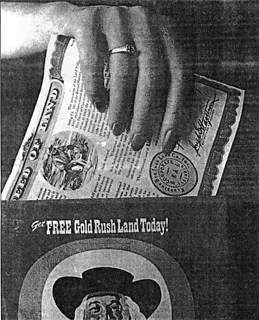
RFF#40 – In 1955, the “prize” inside the Quaker Oats cereal box was a deed for one square inch of land in the Yukon

At the time, Quaker Oats had a radio show called “Mountie in the Yukon”, and after struggling to find a way to promote Quaker Oats, they came up with the perfect idea…every box of Quaker oats would contain a deed for a piece of land where the fictional show took place.

The original deed that appeared in 1955 cereal boxes

Apparently, it was one of the most successful sales promotions in North American business history, all of the boxes (containing deeds) were sold within weeks.

freegoldrushland

Unfortunately, the deeds were never formally registered, and as a result, no one ever actually owned the land. In 1965, the company that was established to handle the land affairs went out of business, and the Canadian government repossessed all of the land.

Apparently thousands of supposed “land owners” still write to officials in the Yukon, inquiring about their property.

I learned about this fact from: http://www.yukoninfo.com/klondikebiginch.htm

Photo credit: http://www.yukoninfo.com/klondikebiginch.htm

RFF#39 – In 1902, the “prize” inside the Quaker Oats cereal box was a deed to a small piece of land

Apparently they were very small lots (some as small as 100 square feet) in Milford, Connecticut. Very few people claimed their prize, which required you to mail the box top to New York , where the deed was then forwarded to Milford to be registered. As a result, in the 1970s developers foreclosed the land to make way for a factory.

Gee, this makes the sparkly crayon I once got in a cereal box seem pretty dingy. Nevertheless, this wasn’t the only time Quaker Oats gave land away…more on that in tomorrow’s post.

I learned about this fact from: http://www.ctpost.com/local/article/Oatmeal-lots-gave-officials-indigestion-687006.php

RFF#37 – Some people are salt resistant, therefore unlike most people, salt doesn’t raise their blood pressure

Those of you who know me might be shocked to hear me say this. But it is indeed a fact. Nevertheless, this doesn’t mean that those are who “salt resistant” don’t have to worry about their salt consumption. For starters, the adverse effects of salt go beyond its ability to raise blood pressure. There is some evidence to suggest that salt intake increases risk for gastric cancer, and salt is even an indirect contributor to obesity (because it makes you thirsty, and if you’re satisfying your thirst with caloric beverages, this could be a problem).

Furthermore, most salty food is processed, so even if you’re salt resistant, the other adverse effects of those foods will probably get you in some other way. Not to mention, salt makes food hyper-palatable (translation: super tasty), and more salt means more cravings. So whether you’re salt resistant or not, the take home message is still the same, excessive sodium consumption is bad, and it’s something we all need to work on.

I learned about this fact from: Strom et al. Sodium Intake in Populations: Assessment of Evidence. Institute of Medicine, 2013.

RFF#34 – Corn is a man-made grain

Because corn has never been found in a truly wild state, it’s believed that it likely emerged as a result of the hybridization of two grasses somewhere in Ancient Mexico. And thanks to Christopher Columbus, who stumbled upon it in Cuba, it eventually made its way to Europe and beyond.

I learned about this fact from: Hawjes, AD. A World of Vegetable Cookery – An Encyclopedia Treasury of Recipes, Botany and Lore of the Vegetable Kingdom. Simon and Schuster, New York: 1968.

RFF#33 – Ice cream cones were popularized at the 1904 World’s Fair when an ice cream vendor ran out of cups and a waffle vendor helped him out

As the story goes, Ernest Hamuri, a Syrian immigrant, was the waffle vendor who rolled up his waffles for Arnold Fornachou, the teenage ice cream vendor who had run out of paper cups, at the 1904 World’s Fair in St. Louis, Missouri. Apparently the “waffle cone” took off immediately and many of the other ice cream and waffle vendors at the fair quickly collaborated to copy their creation.

There’s debate over who actually invented the ice cream cone. While this was probably the first major appearance of the edible, conical shaped waffle cone we all know and love, other edible ice cream containers of various sorts were recorded as early as the 1700s. As a matter of fact, an Italian immigrant by the name of Italo Marchiony held the first patent for an ice cream cone mold, in 1903. However, his “cone” apparently was more like a cup with handles.

This diagram is from Marchiony's 1903 patent application, illustrating his ice cream cup mold

This diagram is from Marchiony’s 1903 patent application, illustrating his ice cream cup mold

One point of clarification, it’s likely that Hamuri wasn’t technically selling “waffles” but rather, “zalabia”, which is a flat, waffle like pastry that is popular in the middle east.

I learned about this fact from: Dr. Bob Brewer; http://www.idfa.org/news–views/media-kits/ice-cream/the-history-of-the-ice-cream-c/ and http://www.google.com/patents?id=kBVUAAAAEBAJ&pg=PA1&source=gbs_selected_pages&cad=2#v=onepage&q&f=false

If you’d like to see Marchiony’s original patent application click here

RFF#31 – The glycemic index of pasta varies depending on the shape

First, for anyone doesn’t already know, glycemic index (GI) is a measure of how quickly a food is digested and absorbed.

Ideally you want a food to be:

1) slowly digested (so it stays in your stomach longer, keeping you full for longer), and

2) slowly absorbed (so all of its energy doesn’t rush into your bloodstream which causes a hormonal imbalance [too much insulin] and increases the likelihood that the energy will be stored as fat)

Therefore, foods with a low GI (think low=slow) are better than foods with a high GI.

So, which shape is best? Well, it all has to do with the density and surface area of the pasta. Meaning thick and dense pastas, like rotini and gemelli will have a lower GI compared to pastas with a large surface area, like orzo and fettuccine.

But, in addition to the shape, the way in which the pasta was cooked will also influence the GI. More on that in tomorrow’s post…

A selection of pasta at "Campo di Fiori" in Rome

A selection of pasta at “Campo di Fiori” in Rome

RFF#30 – John Harvey Kellogg was a physician and he invented corn flakes in 1895 as a healthy breakfast for his patients

Kellogg was the director of the Battle Creek Sanitarium, a long-term hospital he ran using holistic methods. As a Seventh-day Adventist he believed in, and practiced vegetarianism, abstinence from alcohol and tobacco, as well as regular exercise and enemas.

While Kellogg didn’t want to add sugar to corn flakes, his brother did. This dispute led them to establish separate companies. Unfortunately, his brother’s corn flakes (containing sugar) would eventually become the Kellogg Company staple.

Here’s the best part…Kellogg’s rival, Post Cereals, was started by one of Kellogg’s patients, Charles William Post. And according to Kellogg, Post stole the recipe from the safe in his office.

I learned about this fact from: “Salt, Sugar, Fat – How the Food Giants Hooked Us” by Michael Moss and http://en.wikipedia.org/wiki/John_Harvey_Kellogg

RFF#29 – Ancient chewing gum was made from Mastiha

Mastiha (pronounced: mas-tee-ka) is a natural resin that comes from the Mastic tree (basically an evergreen shrub that was first cultivated on the Greek Island of Chios). People in ancient eastern Mediterranean countries commonly chewed (masticated) it to clean their teeth and freshen their breath. Today it can still be found in commercial chewing gums (among other foods) from Greece and other Eastern Mediterranean countries.

I was so surprised to find modern mastiha gum

I was so surprised to find modern mastiha gum at the grocery store in Athens.

I learned about this fact from: The ELMA gum box.

RFF#27 – Chewing gum is banned in Singapore

Apparently they had too much trouble with people disposing of their gum under tables, on elevator buttons, in mailboxes and even inside keyholes. As a result, in 2004 they banned its importation and consequently you can only get chewing gum with a prescription from a doctor or dentist. Supposedly a black market has yet to emerge, but I can’t verify that.

I learned about this fact from: http://en.wikipedia.org/wiki/Chewing_gum_ban_in_Singapore

RFF#26 – There’s no such thing as “hormone free milk”

For starters, all cow’s milk naturally contains estrogen (and other hormones), so semantically speaking hormone free milk doesn’t exist. The “hormone free milk” label you commonly see on dairy products is usually referring to rBST a synthetic hormone administered to stimulate milk production. However, the reality is, rBST is banned in Canada, so in actuality all Canadian milk could potentially say “rBST free milk”.

But the story doesn’t end there. Even though the estrogen in milk is naturally occurring, its presence is worrisome because the amount of estrogen in modern milk is much higher than in previous generations. This is because traditional herding societies use tactics to minimize the amount of estrogen in their milk—namely, they refrain from milking cows during the late stages of their pregnancy, when they produce 33 times more estrogen—meanwhile presently in North America, most cows are milked 300 days a year. As a result, they’re being milked throughout the cow’s pregnancy, leading to potentially higher estrogen levels. This is concerning because it may be a factor contributing to the rise of estrogen related cancers, including breast, uterine, endometrial and testicular cancer.

I learned about this fact from: http://www.news.harvard.edu/gazette/2006/12.07/11-dairy.html

RFF#25 – The first ever Olympic champion was a baker

His name was Koroibos,  and apparently he won the “stadion”, a 192 meter race, which was the only event at the 776BC Olympics.

If you consider the importance of carbohydrates for athletic performance, this makes a lot of sense, as he probably had more access to carbohydrates compared to anyone else at that time. So, I guess you could say it’s evidence of carbohydrate loading in ancient times.

—I learned about this fact from: http://www.topendsports.com/nutrition/olympic-ancient.htm and http://en.wikipedia.org/wiki/Coroebus_of_Elis

RFF#24 – Some people are “taste blind”, meaning they have a reduced ability to perceive the taste of food

It has to do with the number of taste buds and touch fibers on your tongue. The fewer you have, the less sensitive you are to the taste of food. Apparently, this arises because people who are “taste blind” carry a mutation in the gene that controls a factor (gustin) involved in taste bud development.

A recent study examining people who are “taste blind” compared with people who are “super-tasters” showed that people who are “taste blind” tend to consume more calories. Of course, this is what you’d expect considering that they’re less sensitive to subtle tastes and thus tend to prefer rich foods.

—I learned about this fact from: Tepper, B.J., et al., Greater energy intake from a buffet meal in lean, young women is associated with the 6-n-propylthiouracil (PROP) non-taster phenotype. Appetite, 2011. 56(1): p. 104-10.


RFF#23 – During his presidency, George Bush Senior refused to eat broccoli

Supposedly he even banned it from Air Force One, stating:

“I do not like broccoli. I haven’t liked it since I was a little kid and my mother made me eat it, and I’m president of the United States, and I’m not going to eat any more broccoli.”

I learned about this fact from: http://www.nytimes.com/1990/03/23/us/i-m-president-so-no-more-broccoli.html and http://latimesblogs.latimes.com/washington/2010/08/michelle-obama-beets-george-bush-broccoli.html